
Story by Kamillah Morales
Staff Writer
Photo by Sage Chang
Staff Illustrator
English novelist George Orwell once wrote, “political language is designed to make lies sound truthful and murder respectable.” This is something that has held true recently.
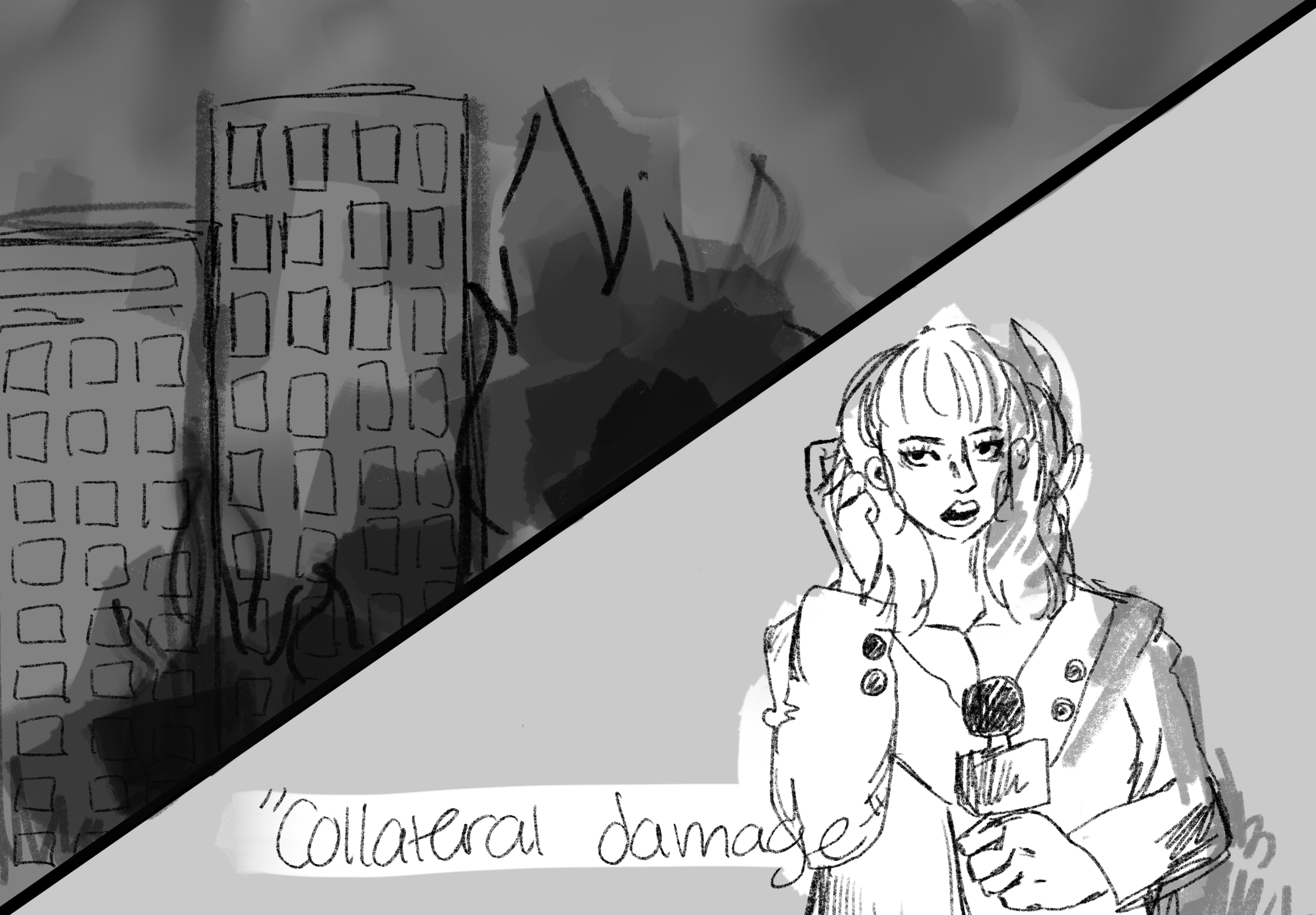
Euphemisms and vague phrasings are often used in politics in order to make lies seem more acceptable and desensitize people from things that are wrong. Using phrases like “collateral damage” instead of “citizens killed” and “enhanced interrogation” rather than “torture” are key examples of the euphemisms used to describe political occurrences. Rather than just getting straight to the point, it has become a common trend in politics to talk in the form of abstract cliches, not only to try to justify one’s own senseless actions, but to also sway how people perceive the situation.
“I think this has always been a thing. I just think it’s gotten way worse with our current political figures, and I think that a lot of them definitely know what they’re saying, but they’re gonna continue saying it because they know that they can get away with it,” sophomore Lucy Gammell.
For example, on Mar. 11, 2026 when the United States and Israel were cooperating in a regional war against Iran, U.S. president Donald Trump described it as an “excursion” where he “had to take a little trip to get rid of some evil, very evil people.” Referring to a war as an excursion is unconscionable — not only because of the desensitization, but because of the way Trump diminished the suffering and lives lost in the war. To start a war is terrible, but to downplay it is even worse because it disregards all the torment war has caused others.
“If a politician chooses to do something bad, they always try to use phrases that kind of die it down a little bit, and they always try to be like, ‘Oh, did I really do this or is it really just this?’ And I think that sometimes it’s like, you know what you did, and you knew it was bad, and you’re still trying to have it die down,” sophomore Zoe Wilson said.
As the language used in politics becomes “flat, hollow, and vague” as described by philosopher Jonny Thompson, society’s thoughts are too. When political figures continuously use these euphemisms, it can shape and limit people’s thoughts into only believing the surface-level things they are told.
“It’s definitely a manipulation tactic … it’s all about trying to make the person interpret it how you want them to interpret it,” Gammell said.
In 1949, Orwell published 1984, a dystopian novel that served as a warning against totalitarianism— a form of government in which the state seeks to exert total control over both the public and private lives of its citizens. Not only was the book a warning, but also a prophecy of what the world would be like in the future. He believed that the future would be filled with mass surveillance, totalitarian trends, and propaganda that he witnessed during and after World War II.
1984 has stayed relevant because in current day politics the predictions of political manipulation Orwell warned about have begun to come true. Orwell strongly believed that manipulation tactics like Newspeak and political euphemisms would become political reality. Newspeak is a fictional language in Orwell’s novel created to systematically shrink vocabulary, simplify grammar, and eliminate words that expressed independent thought, free will, or rebellion. This has now become something that can often be found whether it is on social media posts, or political speakers. When a person retaliates, they are put down and opposed by the government. Newspeak may have been made for fiction, but it has shown to be reality.
“A lot of people, especially in politics, use language to diminish another group, whether it’s calling them something that they’re not, or just stuff like that,” Wilson said. “And I think that a lot of people know that their words have a lot of power, especially when they’re in a place of high power, and they definitely know how to use it to tear other people down.”
The language used in politics has been made to manipulate, not inform. The words coming from political figures are influenced by power and abuse, euphemisms and cliches, and the predictions and beliefs of Orwell played a part in the realization of the way language is made muddy. It is crucial that people realize this great flaw in political language to not let it influence their own perception.