
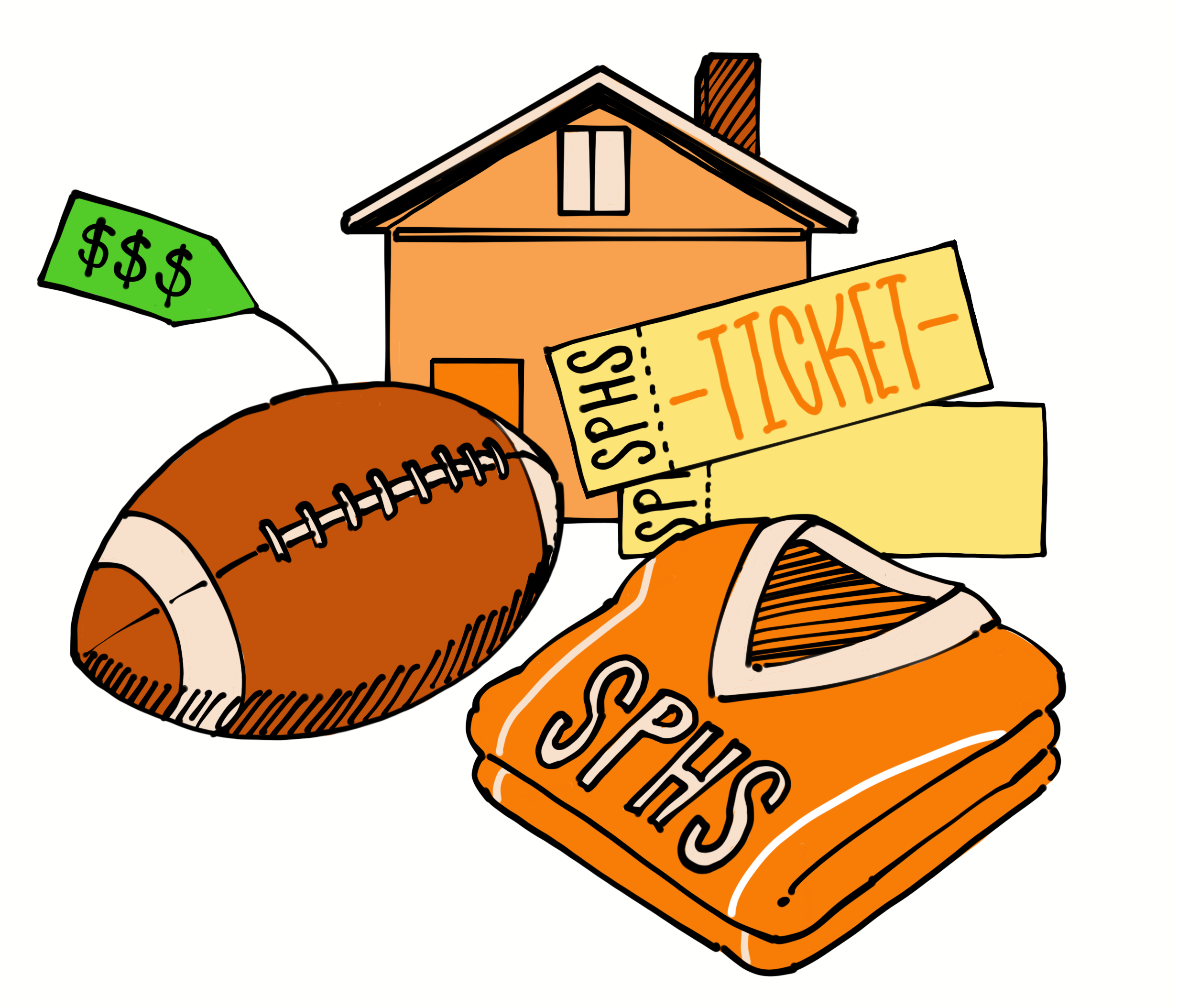
Story by Leighton Kwok and Maya Bennett
Staff Writers
Illustration by Lanah Kim
Staff Illustrator
The negative impacts of income stereotypes
South Pasadena is known for its high-quality education, bustling community, and safe streets, attracting new families to the ever-growing city.
However, one large misconception about South Pasadena is that everyone who lives here is wealthy. With its beautiful Craftsman homes, it is easy to think only of the city’s suburban areas, such as Arroyo Vista and Monterey Hills. But what often fails to be addressed is that the working class makes up the majority of South Pasadena, and the expensive cost of living forces families to work tirelessly to afford. With this misconception, students who may not live in these craftsman homes are often overlooked as “poor”, when, in actuality, this is far from true.
According to U.S. Census data, South Pasadena’s median household income is approximately $127,175. At first glance, that figure appears to support the perception that nearly everyone in the city is financially comfortable. However, the median income only represents the middle of all households and does not reflect the wide variety of circumstances among residents. In addition, the city’s unemployment rate of 5.4 percent is higher than the national average of 4.2 percent, showing that financial stability is not guaranteed for every individual.
Since the city is known for its one million to 15 million dollar homes and high household incomes, the logical assumption is that all families have similar financial situations. In reality, South Pasadena is far more economically diverse than it suggests. With most South Pasadena residents living in apartments and other multi-family style housing, 56 percent of residents are renters. While affluent homeowners contribute to the city’s wealth statistics, they can overshadow the significant number of families living on much tighter budgets.
SPHS is one of the highest-performing public schools in the region, academically ranking higher than Alhambra High School, San Gabriel High School, and Temple City High School. What comes with a high-performing school is more opportunities for extracurriculars. This is through greater funding and the desire for more students to participate in school life. While attending public school is free, many of the experiences that help students become more developed in the student body and community come with additional expenses.
With the cost of living climbing every year and the majority of families focusing on rent for the month and utilities, expenses like homecoming tickets, color day outfits, and spirit days get put on the back burner. Since South Pasadena is a smaller school district, many students who are interested in sports have to pay a large portion out of pocket to fund the program. Individually, these expenses may seem small, but from athletic participation fees, equipment, team apparel, and buses, the extracurricular cost can add up to a large amount throughout the year. This becomes a substantial financial burden than expected for families already balancing high living expenses
Students who may not be able to participate in school activities are seen as “poorer” in the eyes of the student body. In reality, how financial class is perceived is warped due to the very stereotype that everyone in South Pasadena is well off. In areas generally well off, the outliers tend to seem more extreme than in actuality. According to U.S. News, 15 percent of the total student body is economically disadvantaged, and 14 percent are part of the free lunch program.
The Gini coefficient is a numeric measure ranging from zero to one, indicating income inequality in a given city. A lower number indicates greater income equality, with the range of 0.3 to 0.4 being a moderate inequality. South Pasadena’s Gini coefficient is 0.4717, being a little higher than the moderate inequality level, suggesting noticeable variations in income distributions across households, with certain parts of the city holding a larger share of income compared to others. It also indicates that there is more South Pasadena can be doing to enhance economic fairness and reduce the gap between income groups.
Not wanting or being able to go to a school dance or going to a major artist’s concert over the weekend because of financial burdens doesn’t mean that a student is poor. It instead reflects the financial decisions many families must make while balancing transportation expenses, childcare, and other necessities. In a context where wealth is already assumed, these realities can be overlooked and create misconceptions that every student has equal access to the same opportunities.
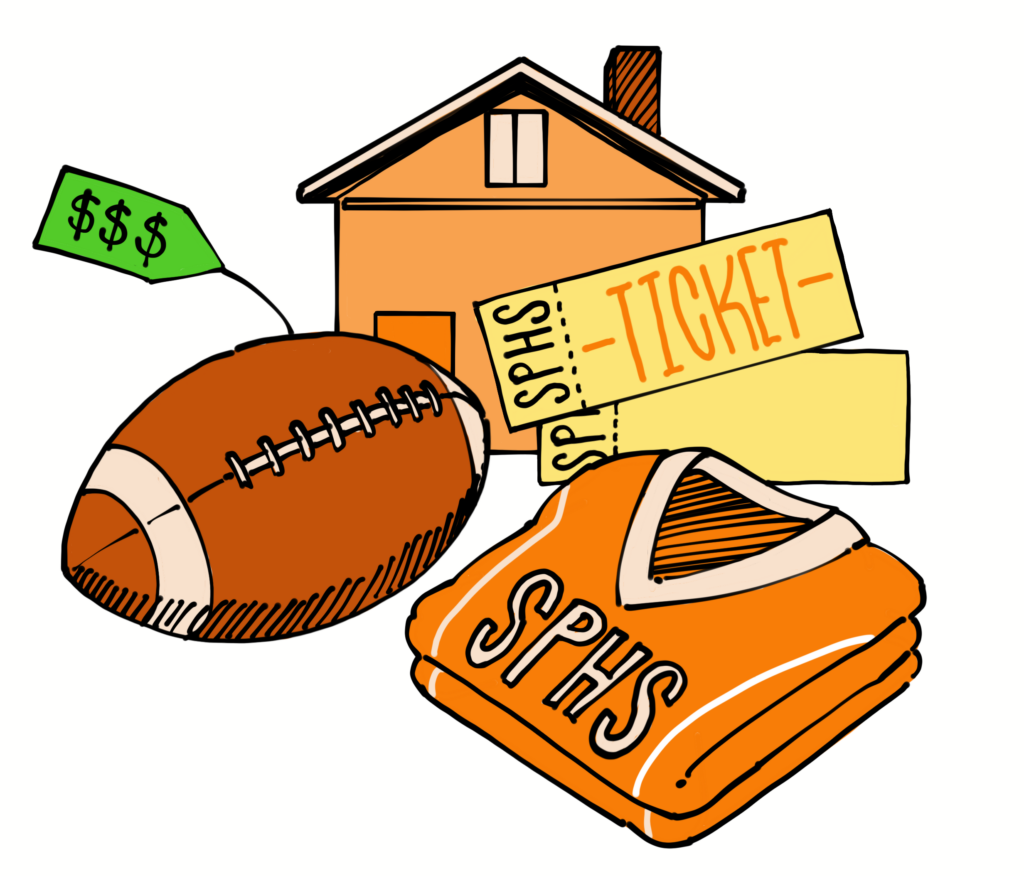
Students’ stunted community participation
It can feel like there is an assumption of wealth in the South Pasadena community, and some SPHS students cannot afford to participate in aspects of the school community, from extracurriculars, like sports and band to purchasing school dance tickets.
“A lot of people don’t really keep track of their finances and their spendings, and those things really do stack up. Whether it’s following the latest trend, [or] going to the latest concert, [these are] barriers against participation for people who don’t have the financial means,” an SPHS student said. All students interviewed for this piece were granted anonymity to protect their privacy.
One of these financial barriers can be seen in a recent school event, the homecoming dance at the Pasadena Convention Center. Tickets to attend were very expensive; the lowest price for the dance, without a SAC card, was $85 in week one, with the highest price being $105 in week three. SAC cards themselves are upwards of $50. To participate in the homecoming picnic, which took place this year on Friday, Oct. 16, students had to purchase picnic tickets that were about $10 to $15 to be able to purchase different foods from a variety of clubs.
Without a SAC card, football and basketball game entry is $10. Theater and dance performance tickets are priced similarly. Many students contemplate buying a SAC card for an additional charge at the start of the year if it means they get discounted prices for dances later.
“So this is the cost that I would save to go to hoco, the Winter Formal, [and] Prom,how much money I would potentially be saving if I go to games,” another SPHS student said. Some SPHS students have to think twice about purchasing something that another student considers as a small cost.
Dances are not the only concerning cost for some students. With the different spirit days that occur at SPHS, some people buy a whole different costume for Color Day or for the different themes at the home football games. Especially on Color Day, participating costs a lot of money, when purchasing inflatable costumes or onesies. Though some students simply do not want to participate, some people are unable to, as they can not afford to buy anything for school events.
Many students at SPHS, regardless of their financial status, do not like spending large amounts of money on dance tickets or school events if the prices are high, an issue only magnified for those with a lower income.
“Sometimes the pricing of the school events can deter me from wanting to attend, [and] I feel as if the scale of the event doesn’t live up to the price I have to pay to go,” an SPHS student said.
In addition, pressure to spend money also extends directly to the parents who are expected to donate for Wish Night, Back to School Night, or other fundraisers to help cover costs in classrooms. However, some students and their families can barely afford their school supplies, so when teachers ask for donation money, they are not able to give any.
Many people face this problem when they participate in extracurricular activities. For sports teams, parents are asked to pay a $150 fee for transportation and bus costs for each sport that their student participates in. To participate in any sport, students also need to get a physical exam with their doctor, which may be an extra cost. Beyond sports, band fees are about $300 per year to participate, as well as PEP uniforms, which cost from $300 to $800.
Financial barriers are not only present when students want to participate in school events and extracurricular activities. They also prevent students from making new friendships, as it is hard to be upfront and straightforward when telling someone about sensitive personal information, such as financial instability. Especially since South Pasadena’s norm is that people are higher middle class, telling someone about financial instability, more often than not, can yield a negative reaction.
“Sharing the fact that you don’t come from the same privilege is very much isolating. So, hanging out with friends, being invited to a hangout, and then having to tell them, ‘oh I can’t afford this, I can’t pay for this’ [is] one of the worst things socially to say to someone, especially [to] people you’re not as close to [and are] trying to form connections [with],” an SPHS student said.
At SPHS, more people are impacted by financial barriers than what is commonly assumed. Many people hide what they are going through and try not to let it affect their school life. The common belief that everyone in South Pasadena can afford expensive school activities and events is not always true, and must be considered when questioning when someone is not participating.