
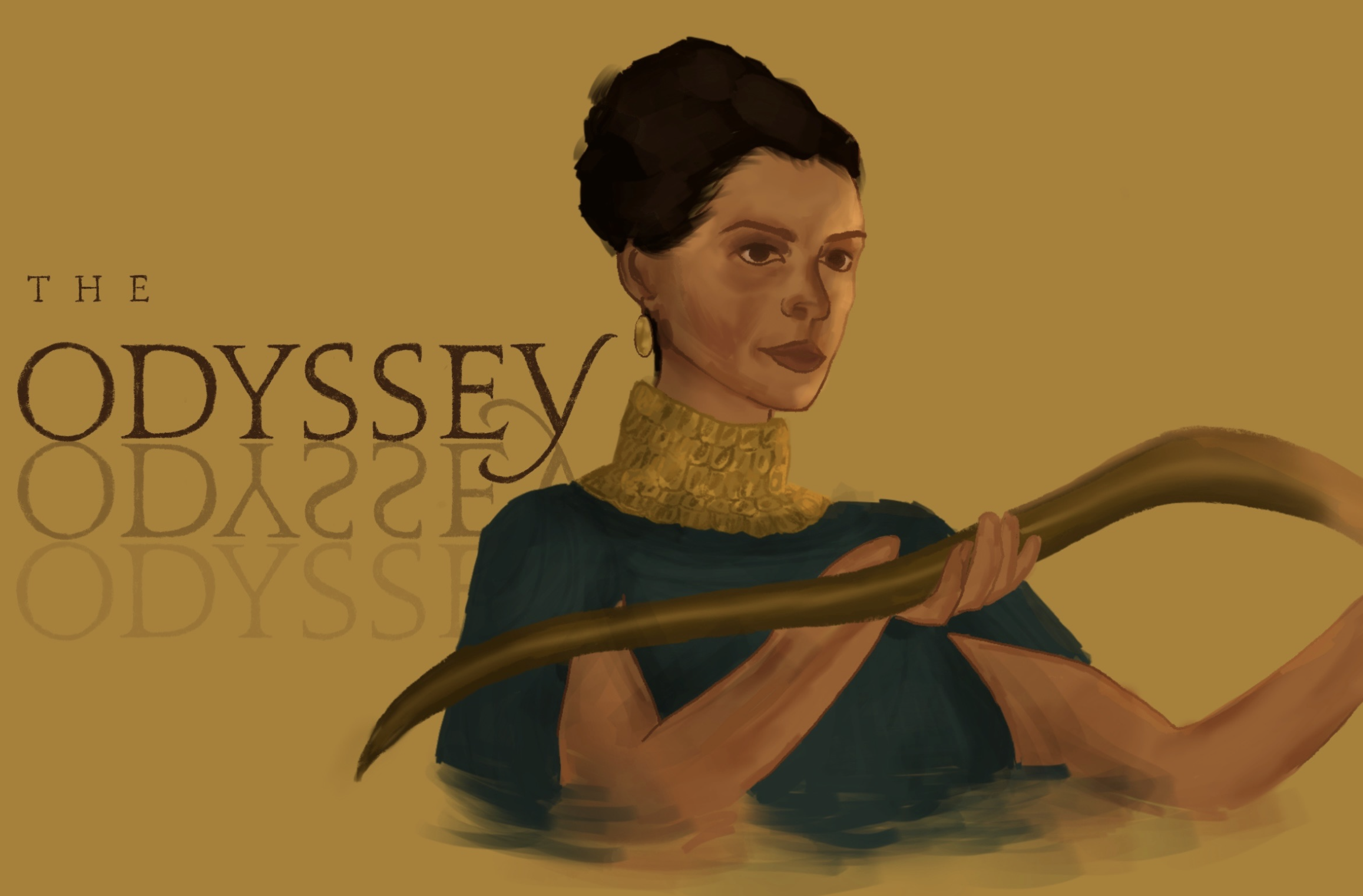
Nolan’s flawless film brings the age-old story of triumph and consequences to life.
Story by Gavin Bartolome and Ellie Song
Sports Editor and Staff Writer
Illustration by Sage Chang
Staff Illustrator
Christopher Nolan’s highly anticipated new movie, The Odyssey, was released on July 6, 2026. The film began with the inspiration of Homer’s The Odyssey, which was written around 800 BC. The cast became a worldwide phenomenon, with Matt Damon playing Odysseus, Anne Hathaway as Penelope, Odysseus’ wife, and Tom Holland taking on Telemachus, the son of Odysseus. Other famous actors who performed in this movie were Zendaya, portraying the goddess of wisdom and war, Athena, Robert Pattinson as the antagonist, Antinous, and even Travis Scott, who was the bard.
“I liked how every actor portrayed their character the way that they did,” sophomore Zoe Wilson said. “I thought that they did a great job with the cast.”
On top of a strong cast, the film’s artistic liberties spoke volumes for its story and individuality among countless retellings of Odysseus’ adventure. Notably, Nolan’s film was the first full-length movie to ever be filmed completely in IMAX cameras. Much like how The Wizard of Oz marked the beginning of true color film, The Odyssey could herald an era of filmmaking dominated by crisp recordings made possible on IMAX.
The film continued to push the envelope beyond impressive filming equipment. Using Homer’s story as an outline, Nolan decided to shoot each scene at real locations, taking pride in not using traditional green screen at all during filming. By the end of production, the cast and crew had traveled across six different countries: Greece, Morocco, Italy, Scotland, Iceland, and Malta.
“It felt in a lot of ways more like an expedition than a movie because of the locations we were at,” Damon said in an interview with CBS. “…we’d have to hike up the mountain to shoot and that part of it ended up being really fun because it was challenging, for everybody there.”
Nolan’s mindset of realism extended to the monsters themselves. The cyclops was, in fact, a 60-foot-tall puppet filmed in a cave in Greece, only blended with actor Bill Irwin’s movements afterward. Meanwhile, the vortex Charybdis was made in real life using jet skis that were erased post-shooting.
At the helm of the project, tying all of Nolan’s complex shots together, was the score. Composed by Ludwig Göransson, who previously composed Oppenheimer’s score, the music perfectly captures not only Nolan’s vision but also the monumental weight that Homer burdened Odysseus with. In part, what makes Göransson’s pieces so entwined with Odysseus is their lack of a traditional orchestra, digging its roots into traditional Greek instruments like the lyre and the aulos.
“It’s not like the orchestra existed back then,” Nolan said in an interview with TIME Magazine. “It was a challenge and also an opening to try to make something unique.”
However, Nolan’s grand film did take some liberties in the story to create his masterpiece, starting with Odysseus. Overall, his character resembles more of a tried-and-true hero who yearns to reconnect with his family rather than the more arrogant and deceitful version written in Homer’s story. Moreover, the amount of divine interference was mostly removed from the story to match Nolan’s goal to make the story more relatable and believable.
“I thought it was a generally good movie, [but] I think that Christopher Nolan could have portrayed the women [such as Penelope, Athena, and Calypso] better,” Wilson explained.
However, none of these changes detracts from the impact of Odysseus’ travels, having the audience silently hope for the scarred hero to make it home at last.