
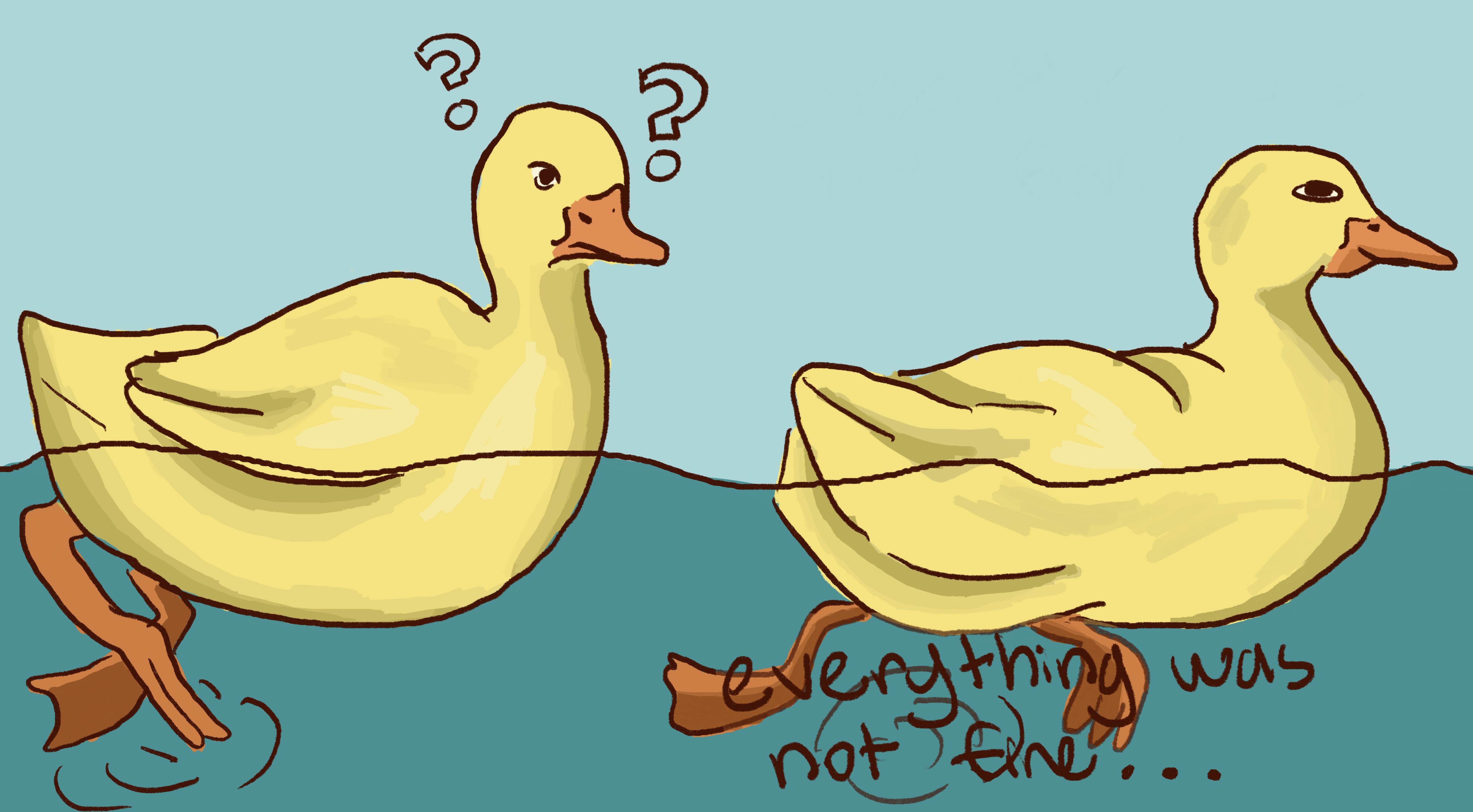
Tiger conducted interviews with students of all grade levels and put out a Google Form survey that received 234 responses, or about 16 percent of the student body. This spread aims to shine light on the things students do to present perfect images of themselves and to understand why students feel the need to hide all struggles from their peers. This spread ran in Tiger‘s February 2026 print issue; view the PDF here.
Story by Uma Chakraborty, Harriet Godson, Leighton Kwok, Anna McDonnell, Ellie Song & Zoe Chen
Staff Writers & Print Managing Editor
Illustration by Diana Lopez
Staff Illustrator
Graphs by Zoe Chen
Print Managing Editor
Contents
- Duck syndrome definition
- Pull quotes
- Why do students hide their struggles?
- Manifestations of duck syndrome
- Student survey data analysis
- Student survey graphs
Duck syndrome definition
Picture a duck swimming in a pond: On the surface, the duck glides smoothly over the water. Below the surface, the duck is kicking furiously to stay afloat.
Duck syndrome is a feeling experienced by individuals based on their own belief that
- Their peers are near-effortlessly successful
- The individual must work furiously to keep up with their peers
- The individual must hide how much they are struggling based on the self-belief that it should not be this hard for them
Duck syndrome is especially prevalent at high-achieving institutions like SPHS. It is not a clinical term or health diagnosis.
Pull quotes


Why do students hide their struggles?
Overall, the motivations of students at SPHS for keeping their struggles private can be placed into three umbrella categories: they do not want to feel less than, they do not want to be judged by others, or they do not want others to worry.
“[My family] wants me to be perfect. So I try to let them see that I’m perfect, even if I’m very much not perfect. I’ve crafted this image around that, and now it’s what everyone sees. And now I can’t break the image … it’s sort of like an obsession, where once you start doing it [trying to be the best at everything all the time], you can’t stop,” junior Yifang Lou said.
Some students expressed the desire to be perceived as effortlessly successful for the sake of their own pride.
“I want to seem nonchalant and like I have it together. I want to seem like I’m not trying,” senior Sammi Keller said. “My ego makes me want to look effortlessly better than everybody else.”
“What do I even have if I’m no longer excelling at everything?” Lou added. “That becomes your identity, being effortlessly successful, being perfect. That’s who you are … and you don’t know who you are outside of that.”
Other students explained fear of judgement from others.
“I’ve lied to my parents, peers and more about my grade, because being a 3.0 student … people look down on you for it. Especially because a lot of people have had straight As for years, and they just can’t comprehend how someone could not be amazing at school, so they assume you’re either unintelligent or lazy,” freshman Kai Adam Ifill said. “l don’t know who could help me without being judgemental. I’ve had stressful experiences in my life where I’ll ask my parents, friends and more for help, but they’ll just get mad, impatient … I don’t want to stake a relationship or my time by asking for help.”
“I can’t admit that I am worse off than I actually am. I’m supposed to be the smart one,” freshman Vincent Angarita added.
Other students discussed shame and fear of burdening others with their problems.
“There’s definitely a shame aspect to it, because especially at South Pas, there’s so many other … people doing more than you, doing it better than you, and they never speak up about the struggles they face. So I feel like if I were to admit that I’m struggling, it would make me inferior to the other people,” Lou said.
Freshman Jayda Ou similarly touched upon the idea of burdening others.
“I find it genuinely embarrassing for people to see me struggle, especially when it seems like no one else is. It makes me look weaker or less capable than others,” Ou said. “In the past, when I was more vocal about struggles, all I would get in return for being open is the feeling of having annoyed or burdened someone, or that I am being judged for my circumstances.”
“I don’t want to seem like a burden, and it makes me feel like a failure,” senior Adelaide Bertolina put simply.
“I prefer to handle my own problems,” sophomore Lucas Ang added.
Some students also admitted not knowing how, or when, to ask their friends, family, and teachers for help.
“It never feels like the right time,” junior Ashley Walton said.
“On one hand, you want to reach out to someone and share your struggles with them and ask for help. But on the other hand, there’s always that part of you that’s doubting,” Lou said. “If I do tell someone that I’m struggling with this, are they going to believe me because of the appearance that I have so painstakingly already crafted? … But honestly, who knows? Maybe South Pasadena is just one giant flock of ducks.”
Manifestations of duck syndrome
People experience duck syndrome in different ways. Whether it manifests itself in pretending to be effortlessly perfect or in avoiding asking for help out of shame, it is hard not to compare oneself to peers. Tiger aims to shine a light on ways people have hidden their struggles and show what really happens beneath the surface.
“It’s hard because there are people who barely study and get perfect grades, and meanwhile I’m over here studying away but I’m still not getting grades as good as them,” sophomore Pei-Chen Ng said. “After tests, it feels like everyone says, ‘That was so easy,’ and I often feel like, ‘Am I the odd one out?’ It feels like everyone is such a high achiever, and it’s hard for me to keep up.”
Senior Adelaide Bertolina explained feeling as if she were “drowning in homework and doing bad on tests” in an environment where “everyone around you seems to have everything come easy to them.”
Freshman Jayda Ou expressed similar feelings. “When I have a test … I refrain from telling others how much I studied to do well,” Ou said. “There are people out there who did not have to study and work hard for the good grade they received, and it makes me feel less smart if I had to work hard to achieve the same grade.”
“I feel stupid all the time. I constantly feel behind when I shouldn’t, when it seems like everyone else just gets it,” freshman Luna Burg added. “I struggle to ask for help with my schoolwork because other people don’t know how my brain specifically works and how I can receive help.”
Comparison thrives in and out of the classroom, and duck syndrome does not pertain exclusively to academics. The pressure to succeed amid competitive environments is present in extracurriculars as well. Junior Yifang Lou experienced the feeling during a team dinner as her team celebrated their recent competition results.
“The entire time I couldn’t eat or anything; I just felt really, really overwhelmingly sad. The reason was, it’s really dumb, but it’s because I got second place … and I didn’t get first,” Lou said. “You’re always trying to do so many things that you’re not directing enough energy to be first place in anything. And then when you’re not in first place, you get all caught up in it. It’s a loop.”
Students tend to prefer to keep their struggles to themselves and shield themselves from possible judgment, even if this means lying or avoiding getting additional support.
“‘When teachers or your friends ask you, ‘Hey, are you doing okay?’ or, ‘Hey, how are you feeling?’ your default answer is supposed to be, ‘Oh, I’m doing fine.’ Not because you actually are, but because it’s social politeness,” Lou said. “What are you supposed to say? ‘No, I’m not doing well’? That’s just inconveniencing the other person into thinking about a very difficult conversation.”
Duck syndrome is hard to describe, both because it is inherently secretive and because it takes form differently in different people.
“Duck syndrome is such a vulnerable topic,” Ng said. “It’s hard to shine light on it, because the whole point is that everyone feels like they need to hide. Nobody wants to be the one who admits that they’re struggling.”
Student survey data analysis
- 234 students out of the school’s 1492 students (16.3 percent) responded to Tiger’s survey; 39.9 percent were freshmen, 14.5 percent were sophomores, 17.5 percent were juniors, and 28.1 percent were seniors
- 81.97 percent of underclassmen identified as ducks, while 85.55 percent of upperclassmen (3.58 percent more) did
- Academics were the distinctive number one reason why students (85.3 percent) feel like ducks; Athletics, personality, physical appearance, and mental health each hovered around 40 percent
- Students, on average, did not feel pressure because their siblings or family members were high achievers; However, pressure felt because of peers skewed higher (see graph on left/right/above)
- 64.75 percent of all students believed they must work harder than their peers to match their peers’ level and/or to stay on top; This number was even between under and upperclassmen
- Underclassmen believed, on average, that they themselves have situations 0.4 points on a 5-point scale harder than their peers; Upperclassmen found the difference to be 0.2
- 9.28 percent more upperclassmen than underclassmen believed they study longer than their peers and spend more time on homework than their peers (believing peers complete tasks more effortlessly is a key indicator of duck syndrome)
- Overall, 37.89 percent of all students believe they spend the same amount of time on homework and study as their peers, 26.43 percent think their peers spend more time than they do, and 35.68 percent think their peers spend less time than they do
- 32.7 percent of students refrain from asking for help because it would mean admitting that they have not lived up to others’ expectations; 51.2 percent of students (18.5 percent more) refrain from asking for help because it would mean admitting that they have not lived up to their own expectations
Student survey graphs


