
Story by: Maya Bennett and Philip Kwak
Staff Writer and Staff Photographer
Illustration by: Lanah Kim
Staff Illustrator
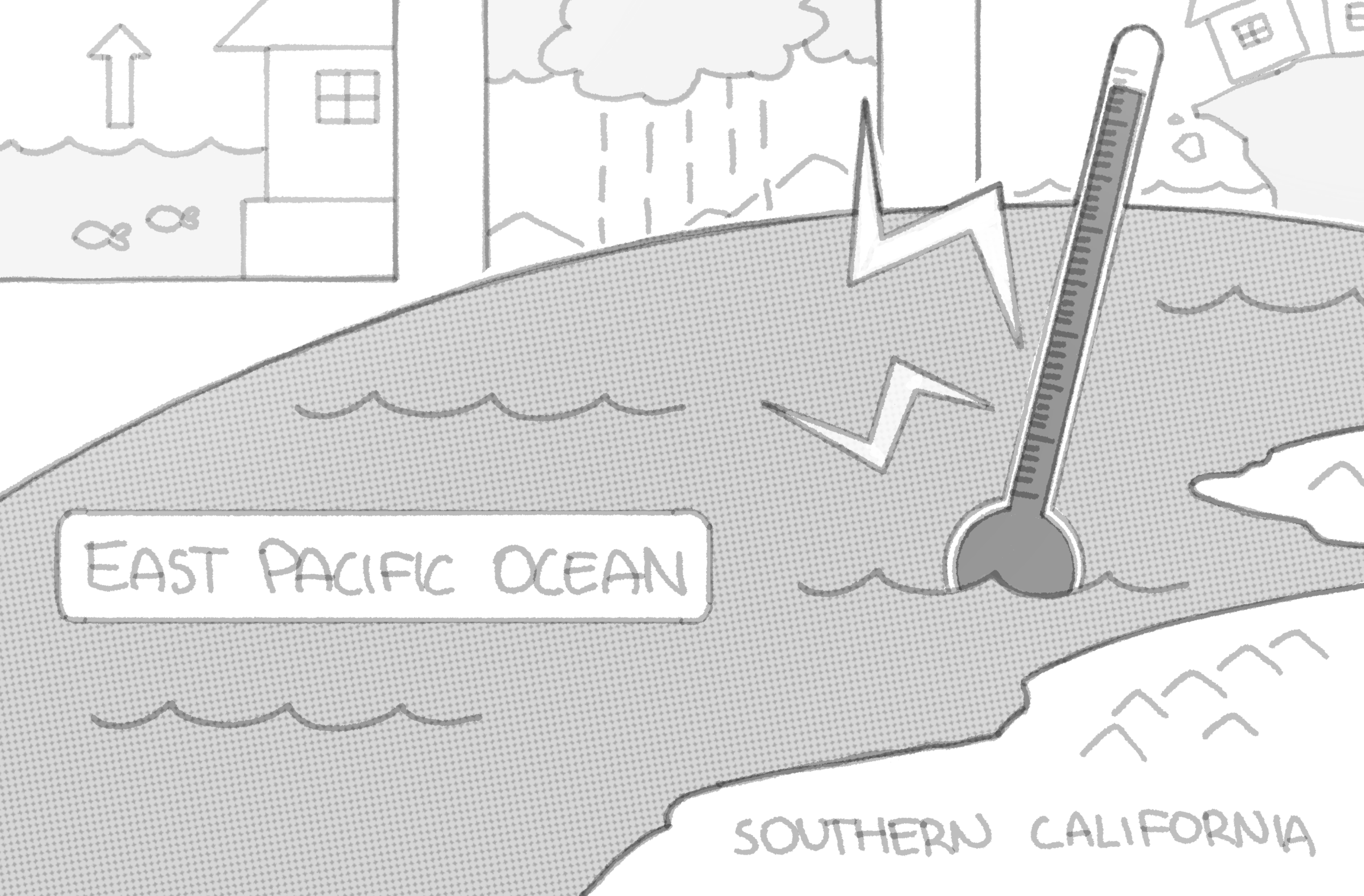
The Super El Niño of 2026, fueled by climate change, is impacting this year’s winter.
This year’s Super El Niño has dominated headlines recently, but beneath the rain and weather forecasts is a climate phenomenon that has been supercharged by greenhouse gas emissions. El Niño, which means “the little boy” in Spanish, was first coined by Peruvian fishermen in the 17th century who noticed warmer ocean currents arriving on the coast around Christmas time. By definition, El Niño is a natural climate pattern that occurs in the Pacific Ocean when surface water temperatures warm.
Freshman Colin Hsia is very interested in El Niño.
“I think El Niño is pretty interesting. All the weather patterns around the world are gonna change, and in California, we’re gonna get tons of rain,” Hsia said.
Normally, the trade winds blow west, pushing warm water towards Asia. During El Niño, the reliable trade winds weaken and allow warm water to pool around South America and California, bringing heavy moisture with it.
“[El Niño] is going to keep happening and it’s just gonna get worse every time it does,” science club secretary senior Milo Young said.
This year’s El Niño is the strongest since scientists began measuring El Niño in 1950, with certain regions’ surface ocean temperatures surging to 2.5-3 degrees Celsius. In comparison to previous El Niño events, this year’s is record breaking. Scientists have dubbed it as the “Super El Niño”.
However, climate change is also playing a big part in this year’s record breaking El Niño. While El Niño is a natural climate pattern, climate change is not. Climate change, caused by greenhouse gas emissions, has already drastically increased Pacific Ocean temperatures in the past decades. These high ocean temperatures lead to more moisture in the atmosphere and act as fuel for severe weather events. When combined with El Niño’s natural strength, this greenhouse gas fueled “Super El Niño” creates the perfect storm, surpassing all the previous records.
Coastal Cleanup Club president sophomore Jayda Ou Estrada goes to different beaches to help pick up trash and spread awareness about climate change and environmental stewardship.
“I think climate change is a really large issue that impacts us severely, and I think that us humans have piled on so many issues that we’ve gotten buried under it,” Ou Estrada said. “But it actually is really severe, and we need to take action to help fix it and contribute to saving our environment.”
Recent coastal storms have battered Southern California with high surf and caused flooding in Long Beach and Newport Beach, destroying homes and causing beach erosion.
“[The flooding] is causing a lot of coastal erosion and a lot of damage to beachside property, which is really bad,” Young said.
Southern California has also seen rare marine life showing up in its coastal waters, from whale sharks, to 12 foot great white sharks, endangered manta rays, and pods of orcas. These rare marine animals are leaving their native waters to follow the warm waters. Wildfire burn scar areas such as the Palisades and Altadena, are under a high risk of mud slides and flash floods. Trees, shrubs, and plant roots act as a natural barrier that holds soil down. Wildfires destroy these natural barriers that protect hillsides from eroding and caving in.
South Pasadena has already experienced some of these effects from El Niño. The remnants of Tropical Storm Rachel caused a brief thunderstorm in South Pasadena. El Niño has also caused extreme heat waves in September and October, with temperatures reaching triple digits.
To prepare for this year’s Super El Niño, FEMA recommends a 3 day supply of non-perishable foods, such as cans and dehydrated meals and one gallon of water a day per person. Homeowners should also clear out drain gutters, inspect their roofs, and use water diversion tools, such as sand bags, to ensure that their home remains safe from flooding.
Climate change is supercharging this year’s record breaking El Niño, transforming a natural climate cycle into a historic perfect storm. As tides rise and storms brew in the pacific, students should begin preparation at home. By staying informed, clearing out rain gutters, and supporting climate action, students can help return El Niño into the natural phenomenon it once was.