
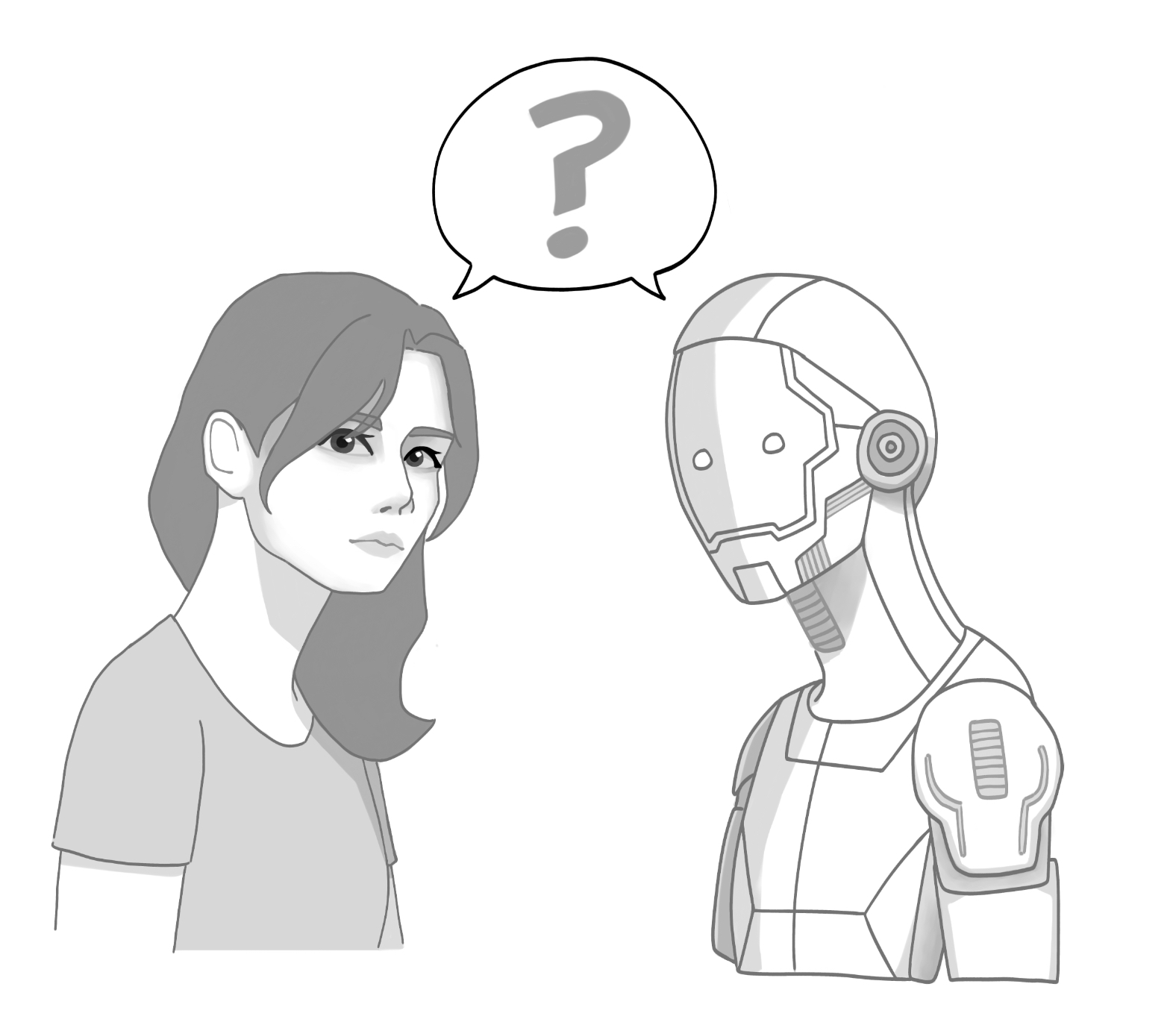
Story by Maya Bennett
Staff Writer
Illustration by Harper Rentmeester
Staff Illustrator
As society shifts to a technology-based world, the use of Artificial Intelligence (AI) is becoming
more frequent and more accessible. Although AI can be used in helpful ways, it is also becoming more negatively used in educational settings, such as the use of AI to cheat, give answers to assignments and write essays.
Even with these drawbacks, studies have shown that AI has been and is currently being widely adopted into school settings. There are two sides to this, as teachers can find AI helpful for grading, but it can also harm students in more ways than it helps them.
One way that AI is able to help students is by adapting to a student’s speed on test-taking platforms, so that they can learn at the speed that works for them. For instance, if a student is slower at reading comprehension, the testing platform may give them more time to complete that specific task. Another example includes speech recognition softwares that help provide an effective learning environment, as they can read out the text for hearing-impaired students. AI can also help students by providing them with immediate feedback and turning complex content into an easier read for the individual.
Although AI can be helpful, there have been more cases of it harming students rather than actually helping them. One of the main reasons is the fact that AI reduces human interactions such as asking a teacher or peer to explain a difficult concept. Therefore, it hinders students’ social skills and possibly prevents them from actually learning.
AI also gives students an excuse to not have to think critically on assignments by simply providing the answer. By not taking the time to solve the problem, students are not able to properly learn and understand the concept. This hinders their growth and prevents them from achieving academic success.
Additionally, when students put a lot of time and effort into their work, they can sometimes end up getting the same grade as a student who cheated by asking AI to write their paper. This is extremely unfair for all of the students who are actually trying in the class and creates an environment where the final product and grade matters more than the actual work behind it.
On the other hand, AI is generally more beneficial for teachers than it is for students. Some common tasks teachers are able to give an AI bot include handling administrative tasks like grading, scheduling, communicating, lesson planning, and managing students’ records.
Since teachers end up using AI for all of their time-consuming work, they are able to have more hands-on time with students. They then have more time to build relationships with different classes and individual students because they are not spending all of their time grading students’ work by hand. With these student-teacher interactions, students’ emotional and social health can thrive.
Some alternatives to AI that SPHS teachers do utilize include sharing lesson plans or worksheets so that each teacher has less work to do and can have each other’s perspectives on different things. Students could also be encouraged to have study groups and collaboration times to do their homework and discuss with one another in order to limit help from AI.
Finally, a push that teachers could make to motivate their students is for them to participate during class and have moments for partner and group assignments. They can do this by trying a collaborative technique called “Think-Pair-Share”, where students can think of the idea themselves, discuss it with a partner, and then share it with the whole class.
Randomly selecting students to participate in class is also another way to get students to share in class, as they are more obliged to participate.